 It is our natural tendency as parents (and often as partners as well) to pay attention to, and focus more on what is wrong, rather than what is right. As a result, our children and teens feel unappreciated and become less motivated to change or improve their behavior. In addition, they quickly learn that they can get more of our attention through negative behavior or “acting out.”
Rethinking Positive Emotion (A.M. Paul)
 Based on an article by Annie Murphy Paul, The Uses and Abuses of Optimism and Pessimism, in Psychology Today (11.01.11)
In recent years it feels like we’ve all been ordered to always “think positive” by an army of experts in any number of fields. Doctors inform us that optimism improves our health and helps us live longer. Corporate coaches advise us that optimistic employees earn more money and climb the career ladder more quickly. “Positive psychology” researchers produce studies showing that optimistic people are happier and have more friends.
Not Under My Roof!
 In her book Not Under My Roof: Parents, Teens and the Culture of Sex, sociologist Amy Schalet traces the roots of parents’ divergent attitudes, and explores the way family culture shapes not just sex but also alcohol consumption and parent-teen relationships. Her work challenges American parents — for whom teenage sex is something to be feared and forbidden, and often a source of family conflict — to consider different, and possible better ways to love, respect and care for our children.
Another Problem with Porn
 Writing for Slate magazine (11.18.2011), Amanda Marcotte points at several signs that “truly comprehensive sex education [is] an idea whose time has finally come.” For years now, she writes, the debate over sex education in the mainstream has been along the lines of, “Do we tell kids sex is an awful thing and they shouldn’t do it at all, or do we tell kids sex is an awful thing, but if they must, here’s how to be safe?” Marcotte argues for a third approach — a comprehensive sex education program that teaches young people to have not just healthy, but pleasurable sex.
It’s Not What You Say; It’s How You Say It (or: Counting Words)
 Be careful every time you open you mouth; the way you speak (and not just the content of what you say) discloses more about your true feelings and unconscious feelings than you are aware, or even may intend. This notion drew my attention this morning, as I listened to an interview with (Univ. of Texas) linguistic psychologist James Pennebaker, speaking about his new book The Secret Life of Pronouns.
Mother-Daughter Conflicts (Elizabeth Bernstein)
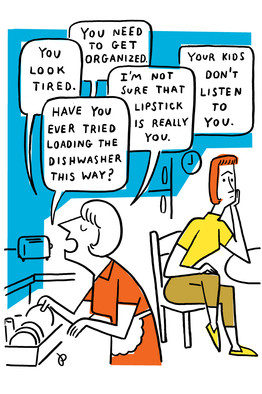
In a recent article in The Wall Street Journal ( ‘I’m Not Your Little Baby!’ Calling a Truce in Mother-Daughter Conflict, 4.24.12), columnist Elizabeth Bernstein examines the lifelong friction between mothers and daughters. The following is an excerpt.
It’s common for mother-daughter relations to be stormy in the daughter’s teen years. But why do mothers and daughters continue to push one another’s buttons well into adulthood?
Six Blind Men and an Elephant

In the wonderful ancient Indian tale The Six Blind Men and the Elephant (made popular by 19th-century English poet John Godfrey Saxe), six blind men touch an elephant. Although each man touches the same animal, his determination of the elephant is based only on what he is able to perceive.
Why Does My Teenager Fight with Me?
 In an article that appeared in Domestic Intelligence (1.19.2009), psychologist and writer Dr. Terri Apter suggests that recent discoveries about the still-developing adolescent human brain and traditional explanations about raging teenage hormones do not sufficiently explain the teen’s experience of parents. And they therefore do not sufficiently help us understand why teenagers fight so much with their parents.