
I appreciated New York Times blog-writer Tara Parker-Pope’s suggestion to replace New Year resolutions with mission statements. This posting is abridged from her longer posting, Creating a New Mission Statement (1.5.2015).
simcha's postings about love, connection, parenting & personal growth
I appreciated New York Times blog-writer Tara Parker-Pope’s suggestion to replace New Year resolutions with mission statements. This posting is abridged from her longer posting, Creating a New Mission Statement (1.5.2015).
 Wendy Wood, a professor of psychology and business at the University of Southern California, says that a habit only becomes bad “when it starts interfering with other important goals you may have.” This piece is adapted from the New York Times article Turning a New Year’s Resolution Into Action With the Facts (1.9.2015).
 Although this article strays a bit from “Psychotherapy” and “Personal Growth,” I found it an interesting look at the relationship between self-beautification and the sexualization of women. Author Madeleine Marsh, who wrote a history entitled Compacts and Cosmetics: Beauty from Victorian Times to the Present, explores the history of cosmetics and lipstick; she suggests that — contrary to common knowledge — red lipstick in particular has been a symbol of female strength, especially in the past century.
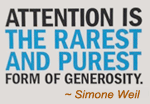 In an article from The New York Times Magazine (“The Generous Marriage,” 12.11.11), Tara Parker-Pope shared the latest research from the University of Virginia’s National Marriage Project. According to this study, GENEROSITY — “the virtue of giving good things to one’s spouse freely and abundantly” — was a predictor of “very happy” marriages.
 Perfectionism — the pursuit of unrealistic standards for ourselves and for our partner — inevitably creates difficulties in the relationship (in general) and in the bedroom (in particular). Psychologists and relationship counselors around the world encourage greater tolerance of human imperfection and a recalibration of expectation.
 Many couples struggle with the giving and receiving of criticism. Often framed in ways that shame, blame, belittle or humiliate, criticism is rarely well-received and usually results in defensiveness and disengagement. A helpful way to get around these pitfalls is to think in terms of constructive, honest and engaged feedback.
 In an article in today’s New York Times entitled Hello, Stranger (4.25.14), Professors Elizabeth Dunn (Univ. of BC) and Michael Norton (Harvard Business School) describe how the casual social interactions we often avoid may lift our spirits and actually make us happier. This has definitely been my own experience. I share here selections from their article.

In a compelling piece in yesterday’s New York Times (Ease and Ardor, 2.27.14), op-ed columnist David Brooks takes a close look at two of the greatest essayists who ever lived: Michel de Montaigne and Samuel Johnson.
Brooks notes how the two men tackled similar problems and were fascinated by some of the same perplexities, yet emerged with different attitudes towards adversity and living life: Montaigne focused on self-understanding and self-acceptance, while Johnson sought self-conquest and self-improvement; where the former sought a life of wisdom and restraint, the latter pursued a life of improvement and ardor.