Aug 04 / Simcha

Reexamining Desire in Women (M. Castleman)

 Naked Young Woman in Front of Mirror (detail), Giovanni Bellini (c. 1430–1516)
Young Woman in Front of Mirror (detail), Giovanni Bellini (c. 1430–1516)

Recent studies have challenged the conventional wisdom that desire must precede sexual arousal; they claim, contrary to this model, that for many women, desire is not the cause of lovemaking, but rather, its result, particularly in long-term relationships.

This approach is outlined in an article by Michael Castleman* that appeared Psychology Today in 2009 (Desire In Women: Does It Lead To Sex? Or Result From It?).

Read more

Aug 04 / Simcha

Removing Perfectionism from the Bedroom (M. Huston)

bedPerfectionism — the pursuit of unrealistic standards for ourselves and for our partner — inevitably creates difficulties in the relationship (in general) and in the bedroom (in particular). Psychologists and relationship counselors around the world encourage greater tolerance of human imperfection and a recalibration of expectation.

Read more

Apr 29 / Simcha

Giving Feedback That Can Be Heard (B. Brown)

checklist1Many couples struggle with the giving and receiving  of criticism. Often framed in ways that shame, blame, belittle or humiliate, criticism is rarely well-received and usually results in defensiveness and disengagement.  A helpful way to get around these pitfalls is to think in terms of constructive, honest and engaged feedback.

Read more

Apr 28 / Simcha

An Easy Tip to Improve Your Mood (Dunn & Norton)

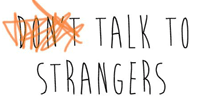
dontIn an article in today’s New York Times entitled Hello, Stranger (4.25.14), Professors Elizabeth Dunn (Univ. of BC) and Michael Norton (Harvard Business School) describe how the casual social interactions we often avoid may lift our spirits and actually make us happier.  This has definitely been my own experience.  I share here selections from their article.

Read more

Mar 12 / Simcha

Kissing: Gender Differences – Part 2 (N. Shpancer)

kiss2In his Psychology Today article “What’s in a Kiss?,” psychology professor Noam Sphancer explores “the kiss as ambassador and spy in sexual politics.”  In this second posting on kissing abridged from his original article, Shpancer notes an interesting set of research findings related to gender differences in attitudes and expectations about kissing.

Read more

Mar 11 / Simcha

What’s in a Kiss? – Part 1 (N. Shpancer)

kissKissing is a cross-cultural and global experience.  In this and the next posting, we will look at the function of kissing according to various psychologists, and then at gender differences in attitudes and expectations about kissing.

These postings are selected and abridged from psychology professor Noam Shpancer’s article (Psychology Today, 2.02.13) on “the kiss as ambassador and spy in sexual politics.”  Please note that some (though not all) of his analysis relates more to the dynamics of heterosexual kissing.

Read more

Mar 01 / Simcha

Self-Acceptance or Self-Improvement? (D. Brooks)

acceptchange
Art: Andrew Cleary

In a compelling piece in yesterday’s New York Times (Ease and Ardor, 2.27.14), op-ed columnist David Brooks takes a close look at two of the greatest essayists who ever lived: Michel de Montaigne and Samuel Johnson.

Brooks notes how the two men tackled similar problems and were fascinated by some of the same perplexities, yet emerged with different attitudes towards adversity and  living life: Montaigne focused on self-understanding and self-acceptance, while Johnson sought self-conquest and self-improvement; where the former sought a life of wisdom and restraint, the latter pursued a life of improvement and ardor.

Read more