
I appreciated New York Times blog-writer Tara Parker-Pope’s suggestion to replace New Year resolutions with mission statements. This posting is abridged from her longer posting, Creating a New Mission Statement (1.5.2015).
simcha's postings about love, connection, parenting & personal growth
I appreciated New York Times blog-writer Tara Parker-Pope’s suggestion to replace New Year resolutions with mission statements. This posting is abridged from her longer posting, Creating a New Mission Statement (1.5.2015).
 Wendy Wood, a professor of psychology and business at the University of Southern California, says that a habit only becomes bad “when it starts interfering with other important goals you may have.” This piece is adapted from the New York Times article Turning a New Year’s Resolution Into Action With the Facts (1.9.2015).
 Although this article strays a bit from “Psychotherapy” and “Personal Growth,” I found it an interesting look at the relationship between self-beautification and the sexualization of women. Author Madeleine Marsh, who wrote a history entitled Compacts and Cosmetics: Beauty from Victorian Times to the Present, explores the history of cosmetics and lipstick; she suggests that — contrary to common knowledge — red lipstick in particular has been a symbol of female strength, especially in the past century.
 In a Washington Post piece (7.18.14) entitled “Are You Raising Nice Kids?“, Amy Joyce helps us focus on raising kind, caring children, rather than over-emphasizing achievement. She shares recommendations from Richard Weissbourd, a Harvard psychologist with the Graduate School of Education, and the Making Caring Common Project about how to raise children to become caring, respectful and responsible adults.
 Clinical psychologist Dr. Kelly Flanagan recently posted a nice piece in the Huffington Post (10.13.14), in which he urges us to look more realistically at the messiness of life and the disappointments of marriage. He lays out the playing field of marriage as one fraught with challenges, yet worth working on in the long haul.
 Relationship has been viewed by researchers as a sequence of developmental stages, a process through which the partners strive for balance between their need for individual autonomy and their desire for togetherness. This particular description of relational stages has been adapted from the work of California psychologist Ellyn Bader.
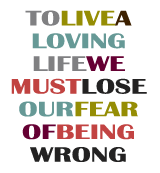 So much of interpersonal strife (like broader political conflict) derives from our insistence on remaining in that “place where we are right.” Our conversations, supported by our sense of certainty and righteousness and devoid of self-questioning, doubt and even love, slide easily into conflict and standoff.
In this brief, beautiful poet, the great Israeli poet Yehuda Amichai* suggests that growth can blossom, not from our certainties, but from our “doubts and loves.” I include both the original Hebrew and the English translation.**
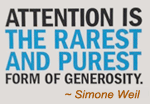 In an article from The New York Times Magazine (“The Generous Marriage,” 12.11.11), Tara Parker-Pope shared the latest research from the University of Virginia’s National Marriage Project. According to this study, GENEROSITY — “the virtue of giving good things to one’s spouse freely and abundantly” — was a predictor of “very happy” marriages.